
Artificial Intelligence (AI) has made remarkable strides in recent years, and one of the key innovations driving this progress is transfer learning. This technique has reshaped how AI models are developed, enabling faster, more efficient, and more accurate solutions across a variety of fields. For those looking to dive deeper into AI concepts like transfer learning, an AI Course in Ahmedabad at FITA Academy offers specialized training that equips professionals with the skills to leverage this powerful technique in real-world applications.
What is Transfer Learning?
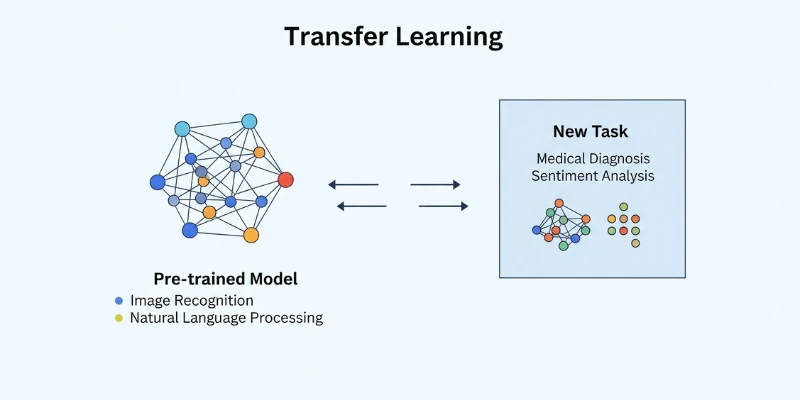
A machine learning technique called transfer learning uses a model that has been developed for one job to be applied to another that is related. Transfer learning enables AI to apply information from a prior task to a new one, rather than creating a model from the start. This is especially helpful in deep learning, where convolutional neural networks (CNNs) are customized for specific tasks following their pre-training on vast datasets.
Benefits of Transfer Learning
Faster Model Training
Training AI models from scratch can be slow and resource-intensive. With transfer learning, models can be pre-trained on a general dataset, significantly speeding up the training process for a new task. For example, a model trained to recognize basic objects in images can be quickly adapted to identify more specific objects like cars or animals. For those interested in mastering these techniques, an Artificial Intelligence Course in Mumbai provides the necessary training to understand and apply transfer learning in various AI projects.
Better Performance with Less Data
Transfer learning allows models to perform well even with smaller datasets. This is especially important in situations where collecting large datasets is difficult or costly. By transferring learned features from a pre-trained model, AI can achieve high accuracy without needing a massive amount of data.
Lower Computational Costs
Building AI models from the ground up requires significant computational power, often involving expensive hardware. Transfer learning reduces these costs by reusing pre-trained models, making AI more accessible to organizations with limited resources.
How Transfer Learning Works
Transfer learning typically involves two stages: pre-training and fine-tuning. During the pre-training phase, a model is trained using a vast, general dataset. It learns fundamental features like shapes and patterns. In the fine-tuning phase, the model is adapted to a smaller, task-specific dataset, adjusting its parameters to perform a specialized task.
For example, a model that has been trained on a vast dataset of general images can be further refined to identify medical conditions from medical imaging or to recognize specific objects like vehicles in self-driving car systems. To gain expertise in such techniques, enrolling in an AI Course in Kolkata can provide you with the knowledge and hands-on experience needed to work with these advanced AI models.
Impact on AI Applications
Healthcare
In healthcare, transfer learning is particularly useful. AI models trained on general medical images can be adapted to detect rare diseases or specific conditions with limited data, enabling faster and more accurate diagnosis.
Natural Language Processing (NLP)
Transfer learning has transformed natural language processing (NLP). Models that have been pre-trained, such as BERT and GPT, undergo fine-tuning for various tasks like sentiment analysis, machine translation, and chatbots, enhancing the effectiveness of AI-powered communication tools.
Autonomous Vehicles
In autonomous driving, transfer learning helps improve object detection. Models trained on general datasets can be fine-tuned to detect specific road objects, enhancing the safety and reliability of self-driving systems.
The Future of Transfer Learning
As AI technology advances, transfer learning is expected to play an even larger role in the development of intelligent systems. Pre-trained models and open-source platforms make it easier for developers to access powerful tools that can be applied to various fields. This democratization of AI will drive faster innovation and help bring AI to industries with limited resources. In order to maintain a competitive edge in this fast-changing domain, enrolling in AI Courses in Delhi can provide you with the skills to harness these advancements and apply them effectively.
In conclusion, transfer learning is revolutionizing AI by making it faster, more efficient, and more accessible. It is paving the way for more innovative solutions across sectors, from healthcare to autonomous vehicles, and will continue to shape the future of AI development.
Also check: Which Technology is Best in Artificial Intelligence?